


Condominium FAQs
Real Estate Branch Services
Condominium associations are set up by law to operate as self-governing entities with minimal government intervention. The Real Estate Branch (“REB”), through its condominium specialists, provides information, and referral services to the Hawaii condominium community, including owners, board members, developers, and general consumers, regarding the Hawaii condominium law, Hawaii Revised Statute (HRS), Chapter 514B, and other condominium-related issues. The educational efforts of the REB are governed by the Condominium Education Trust Fund (CETF), the purpose of which is to finance and promote education and research in the condominium field, promote efficient administration of condominium associations, and promote expeditious and inexpensive procedures for resolving association disputes, including mediation and arbitration. As such, this educational emphasis is consistent with the philosophy underlying the condominium law of self-enforcement by the owners of the association. The REB procures for educational resources such as the Condorama series and the award winning Hawaii Condo Living Guide.
Condominium owners pay $10 once every two years, split between $7 for the operational costs of the Real Estate Branch and Commission (HAR §16-53-16.8(4)), and $3 for subsidized alternative dispute resolution.
The REB also oversees the mandatory registration of most condominiums for initial developer sale to ensure proper and sufficient disclosures are provided to prospective buyers for consumer protection.
The REB website address is www.hawaii.gov/hirec, where you will find information related to condominiums and the work of the REB, in addition to helpful links. E-mail correspondence may be directed to hirec@dcca.hawaii.gov. To ask a question about the condominium law, call a condominium specialist. They may be reached at the REB at (808) 586-2643.
Revised 11/19/2025
The Regulated Industries Complaints Office (RICO) is the agency designated by law to receive certain complaints regarding condominium matters.
The sections of the condominium law over which RICO has been authorized to receive and investigate complaints include:
- HRS, Chapter 514B, Part IV – Registration and administration of condominiums
- HRS, Chapter 514B, Part V – Protection of condominium purchasers
- HRS, section 514B-103 – Condominium association registration
- HRS, section 514B-132 – Condominium managing agents
- HRS, section 514B-134 – Management contracts for the association prior to organization of the association
- HRS, section 514B-149 – Handling and disbursement of association funds
- HRS, sections 514B-152, 153, 154, and 154.5 – Maintenance and provision of association records
- RICO can assist owners in acquiring association records provided in the above listed sections. Please review the Got Records? Information For Condo Owners About Access To Information page.
RICO can be reached at the following through the website
| Oahu: | (808) 587-4272 |
| Kauai: | (808) 274-3141, ext 74272# |
| Maui: | (808) 984-2400, ext 74272# |
| Hawaii: | (808) 974-4000, ext 74272# |
| Molokai & Lanai: | (800) 468-4644, ext 74272# |
For disputes outside of the above-noted sections of the law, i.e., where RICO does not have authority to receive and investigate complaints, the condominium law provides for dispute resolution through mediation, arbitration, or civil litigation. Please review the “Mediation of Condominium Disputes” section.
Please review our brochure, “How Do I File A Complaint?”
Revised 3/19/25
No. Neither the REB nor the Attorney General’s Office have the authority to represent individuals in their private complaints against a condominium association or individuals involved with the association. Persons desiring legal advocacy must consult with a private attorney.
In the process of registering a condominium project for sale, a developer is required to submit certain documents for initial sale to the Hawaii Real Estate Branch (“REB”). The registration application is maintained for ten years, after which the application documents are destroyed pursuant to department file retention policies. Developers may not have updated their reports for changes, may have sold all the units thus ending their reporting requirements, and associations who took control of the project after the end of the developer control period do not have authority to update the registration application. It is highly likely that the map, declaration, bylaws, house rules, sales agreements, and other required documents required during submission that the REB maintains are out of date for older projects.
Should developers or their agents need to review or obtain copies of supporting documents in the developer’s public report (“DPR”), please review our May 2025 brochure on that process.
The Commission maintains a public database of Developer’s Public Reports, but these reports generally contain at most limited summaries of the declaration, bylaws, and house rules. Some reports may contain maps.
Please contact the Bureau of Conveyances for the most updated map, declaration, and bylaws as they are the final recording agency for the state. You may also contact your association as they are required by law to provide owners an accurate copy of the declaration, bylaws, and house rules, along with other records such as financial statements, contracts, and ledgers pursuant to §514B-154.5, HRS. Please review the Commission’s brochure on “Obtaining Documents From The Bureau of Conveyances.”
Should you still wish to request a copy of the documents the REB may have, please submit an UIPA request to access a government record form to this office. You will receive a notice to requester with the office’s capacity to meet your request. If the document request can be met, any fees will be noted. Fees may be paid in cash in person at the cashier’s office, or by a check mailed to the Hawaii Real Estate Branch, payable to the DCCA. Do not mail cash.
Revised 5/30/2025
The Hawaii Real Estate Commission (“Commission”) only receives maps during the initial submission for a Developer’s Public Report or if the developer files an amendment or amended report that changes the map. Furthermore, the Commission does not receive any updates whatsoever to the Developer’s Public Report once the developer sells all units. Any changes by the association are not reported to the Commission and thus the Commission has no records of any changes by an association to a CPR map.
The Commission only retains supporting documents for ten years. Once ten years from submission has passed, the supporting documents, including the ten year old map, are destroyed. The Developer’s Public Reports are retained currently indefinitely, but most do not contain maps. You may access the database for all Developer’s Public Reports here. The map number and recording system (regular or land court) are generally located on page 10 of a chapter 514B, HRS, report and page 6 or 7 of a chapter 514A, HRS, report.
For updated maps, please contact the Bureau of Conveyances or the respective association for the condominium map you are searching for. You may request the maps from the Bureau of Conveyances via the online condominium map form. Maps can also be viewed in person in the Bureau of Conveyances reference room prior to purchase. Please have the map number and recording system for reference. Be aware that Bureau of Conveyances staff are unable to provide the contents of the map via phone or locate any information other than the map.
Revised 5/22
The Hawaii Real Estate Commission only has limited authority and jurisdiction over condominium association of units of owners (AOUOs) governed by HRS, chapter 514B.
The Commission has no authority or jurisdiction over homeowners associations/planned community associations or cooperatives. Homeowners associations/planned community associations are governed by HRS, chapter 421J and cooperatives by HRS, chapter 421I.
Currently, there is no state government agency with jurisdiction, oversight or responsibility of either chapter.
You may call the Hawaii State Bar Association for a legal expert referral at (808) 537-1868 for any issues or concerns regarding homeowners associations/planned community associations or cooperatives.
Revised 4/29/2019
The Hawaii Real Estate Branch solely handles condominiums and real estate licensees such as brokers, sales agents, and real estate education providers.
Real estate appraisers is a separate office within the Department of Commerce and Consumer Affairs. Please see their website.
Assistance with landlord-tenant issues can be found at the Landlord-Tenant Information Center. They are open from 8:00 am to 12:00 pm Monday through Friday except for holidays at (808) 586-2634.
Permitting and subdividing are county jurisdictions:
- Kauai Building Division
- Kauai Planning Department – Subdivision
- City and County of Honolulu – Department of Planning and Permitting
- Maui Department of Planning
- Maui Public Works – Subdivision Section
- County of Hawaii Department of Public Works
The process of subdivision is handled at the county level through their respective permitting and/or subdivision offices, but certain subdivisions do need to register with the DCCA’s subdivision program in order to sell property.
County government has jurisdiction over short term vacation rentals:
Does the Hawaii Real Estate Commission have subdivision public offering statements or timeshare disclosure statements?
No. The Hawaii Real Estate Commission does not handle the registration of subdivisions, to which some subdivisions must file a public offering statement. Please check with the DCCA’s subdivision program for assistance with that matter.
The Hawaii Real Estate Commission also does not handle the timeshare disclosure statements. Please check with the DCCA’s timeshare program for assistance with that matter.
Please check PVL’s contact list for the current mailing, email, and phone number for the respective programs.
The Hawaii Real Estate Commission and Branch occasionally are requested to join task forces to address various issues. Final and interim reports can be found below:
Act 278 – Study of Subdivision and CPR on Agricultural Lands on Oahu Report
Act 189 – Planned Community Association Oversight Task Force Interim Report
11.22.24
1/15/13 [OCP]
The Hawaii Residential Landlord/Tenant Code Handbook is published by the State of Hawaii, Office of Consumer Protection. If you wish to purchase a copy of the handbook, it is available at the Department of Commerce and Consumer Affairs in the King Kalakaua Building at 335 Merchant Street in the Cashier’s office on the third floor and also at the Office of Consumer Protection, 235 South Beretania Street, Room 801. The handbook costs $2.00 and may also be purchased by mail. Send a written request to: The Cashiers Office; Department of Commerce and Consumer Affairs; Post Office Box 541; Honolulu, HI 96809. Checks are to be made payable to the Department of Commerce and Consumer Affairs.
If you have further questions about obtaining a handbook or questions about the Landlord/Tenant Code itself, call the Office of Consumer Protection’s Residential Landlord/Tenant Hotline at 586-2634 Monday through Friday, 8 am to 12 noon.
For a complete copy of the Hawaii Residential Landlord/Tenant Code, you may go to any public library’s reference section and photocopy Chapter 521 of the Hawaii Revised Statutes. You will also find it on our website www.hawaii.gov/dcca/ocp.
There are four reasons why a particular association current renewal registration information is not on the database:
- The association registration renewal application has a deficiency often related to insufficient fees to problems with their fidelity bonding. Lack of fidelity bonding is the most common occurrence for no approval for an association registration renewal. The renewal application is halted until association and their respective managing agents (if any) fix the deficiencies.
- A number of other associations simply did not file their renewal application entirely and while they face late fees, penalties, a loss of standing in court, and no access to subsidized alternative dispute resolution, it is up to the association to file their association registration renewal application. We regularly remind these associations to file, but the Commission cannot file the application on their behalf.
- The approved renewal application is in the process of being uploaded by staff and we appreciate your patience and understanding.
2/27/24
Board Issues And Condominium Law
Congratulations on getting elected or appointed to the board! Your job as a board member, is the vital task of helping run the association through informed and educated decisions. The Hawaii Real Estate Branch (“Branch”) has a wealth of knowledge to assist you in familiarizing yourself with the issues. We also understand that not everyone has hours to spend getting educated.
On the Resources for Condominium Owners, Boards of Directors & Associations page, look for the Ⓑ symbol. The B circled in red signifies a brochure that board members should read to quickly get up to speed on important condominium association issues. These are quick 1-2 minute reads on various topics such as fiduciary duty, agents of the association, the business judgment rule, owner and board member rights and responsibilities, and other key information. This office recommends reading through the various brochures on the website beyond those marked with the Ⓑ symbol when you have time. In addition, the Branch has an award winning series of 15 short videos – all 5 minutes or less – which you can watch to become familiar with common condominium association topics.
The Branch also hosts much more technical and in depth educational material as well, when you have more time to become educated. There are dozens of lengthy videos covering insurance, meetings, lawsuits, budgets, reserves, assistance and emotional support animals, and many, many more. Every quarter, a new Hawaii Condominium Bulletin is released covering varying topics. You may view our condominium bulletin index going back to 2014 to find specific topics with the link to their respective bulletin.
There is also an email subscription list. Signup to receive quarterly emails about upcoming educational classes, new law updates, new bulletins, and other useful condominium information.
7/10/2023
Looking for help on your condominium insurance issues? Check out our insurance section in the Resources for Condominium Owners, Prospective Buyers, Board of Directors, & Associations page.
The Real Estate Branch has heard various form of this question since the repeal of Chapter 514A, HRS.
The failure of a condominium developer to transfer their project into chapter 514B, HRS, does not dissolve, terminate, or otherwise legally end the condominium. That failure of a developer to transfer into chapter 514B, HRS, however, does require the developer to re-register the project to sell developer owned units. Units purchased in an arm’s length transaction from the developer, or purchased from prior purchasers are not impacted and can sell their units pursuant to chapter 508D, HRS, which is the mandatory seller disclosures in real estate transactions. The repeal of chapter 514A, HRS, has no legal impact upon sellers who fall under chapter 508D, HRS.
For more information, please review our resource page on the repeal of chapter 514A, HRS.
4/3/25
The first step to determining what law to apply is determining if your property is a condominium. Sometimes owners have trouble making this determination. The first steps are to check the governing documents to see what law the declaration and bylaws cite. If you see either chapter 514A, or 514B, HRS, in the documents, your property is a condominium. If you bought from a developer, the developer was lawfully required to have given you a paper copy of the project’s Developer’s Public Report.
If you have neither the governing documents or a Developer’s Public Report, you can search on our database for your condominium project here using the Biennial Registration Search database. Should you have evidence that the property is a condominium but cannot locate the Developer’s Public Report in the above database, be aware that the property may be a legal condominium, but was never registered to allow for legal sales with this office. Please contact us at (808) 586-2643 between 7:45 AM – 4:30 PM (Hawaii Standard Time), Monday to Friday, except state holidays for assistance.
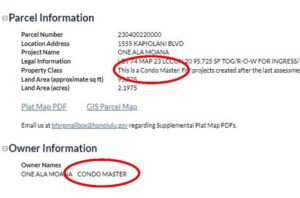
Still can’t find it? The property may be a housing co-operative, subdivision, or a rental complex that was never submitted to condominium. Please be aware that the condominium law does not apply to those types of property and this office has no jurisdiction. You can search for your specific property using the various counties’ real property tax websites listed below:
Properties that are condominiums will note their condominium status, please see example below:
Revised 1/12/23
“Conflict of interest” means an issue in which a director has a direct personal or financial interest not common to other members of the association. HRS § 514B–125(a). A director shall not vote at any board meeting on any issue in which the director has a conflict of interest. A director who has a conflict of interest on any issue before the board shall declare the nature of the conflict before any vote on the issue, and the minutes of the meeting shall record that a disclosure was made.
If you believe a board member has a conflict of interest that prevents this member from representing the interests of the association, you may attempt removal of the board member from the board pursuant to HRS § 514B–106(f). If this is not successful, you may submit the dispute to mediation or arbitration or hire a private attorney. Keep in mind that an important tenet of condominium law is “majority rule”. A majority of owners must support efforts at removal and replacement of a board member in accordance with any provisions in your bylaws regarding the removal and replacement of directors. If removal and replacement is to occur at a special meeting, then the requirements of HRS § 514B-121(b) must also be met.
Revised 8/16/2018
No. All unpaid sums assessed to a unit by the association for common expenses will constitute a lien on the unit. The lien on the unit may be foreclosed by judicial action, or non-judicially by the managing agent or board, acting on behalf of the association. HRS, § 514B-146. The law allows, however, a unit owner who disputes the demand for payment to request a written statement which contains the following information: the unit owner has no right to withhold common expense assessments (only); the unit owner has a right to demand mediation or arbitration to resolve common expense assessment disputes provided the owner immediately pays the common expense assessment in full and keeps the common expense assessment current; the payment shall not prevent the owner from contesting the common expense assessment or receiving a refund of amounts not owed; and the unit owner may demand mediation for any penalty or fine, late fee, lien filing fee, or charges other than common expense assessments, if any, prior to paying those charges. HRS § 514B-146(d). In the alternative to foreclosure, an association may institute an action to recover a money judgment for unpaid common expenses.
Revised 1/7/2019
The use of proxy ballots is governed by HRS § 514B-123. Should you believe proxies are invalid, e.g., invalid on their face pursuant to HRS § 514B-1233, or illegally solicited, you may submit your concern to mediation or arbitration, or consult with a private attorney.
Condominium governance falls under HRS chapter 514B. Certain sections of HRS chapter 514B apply automatically to all condominium associations, regardless of whether the condominium was developed prior to the implementation of HRS chapter 514B on July 1, 2006. Therefore, while you may live in a condominium association that was created under HRS chapter 514A, HRS chapter 514B will govern your condominium project. These automatically-applying provisions are: HRS §§ 514B-3 (to the extent definitions are necessary in construing any of the following provisions), -4, -5, -35, -41(c), -46, -72 and the whole of Part VI (Management of Condominiums).
HRS chapter 514A, has been formally repealed on January 1, 2019 pursuant to Act 181, SLH 2017. Read more about the repeal here.
A copy of HRS Chapter 514B is available here.
Revised 5/10/22
There is no section within Chapter 514B, HRS, that requires an association of unit owners (AOUO) to have or hire a third party managing agent. However, should the declaration or bylaws of a project require a managing agent, then the AOUO would be mandated to follow the governing documents and have a managing agent. Declarations and bylaws may be amended to either add or remove any requirement for a managing agent pursuant to §§514B-32(a)(11), 108(e), and 109(d), HRS.
Large numbers of condominium projects of varying sizes in Hawaii self manage.
Revised 10/16/18
Each unit owner shall afford the association, other unit owners, employees, independent contractors, or agents of the association, during reasonable hours, access through the owner’s unit reasonably necessary for the association’s operation of the property, or for the maintenance, repair, and replacement of the owner’s unit, except to the extent provided by the declaration or bylaws. The association also has the irrevocable right, exercised through the board, to have access to each unit at any time as may be necessary for making emergency repairs to prevent damage to the common elements or to another unit or units. (Section 514B-137, HRS)
Condominium living is a form of community living and thus brings a different set of conditions. Please read our brochure, “Introduction to Condominium Living” for more information on what to expect living in a condominium.
Revised 8/28/18
Yes. Not less than 14 days prior to any association meeting, the secretary or person specified in the bylaws shall cause notice to be hand delivered, sent prepaid by United States mail to the mailing address of each unit, or the address designated in writing by the unit owner or, at the option of the owner by electronic mail to the electronic mailing address designated in writing by the owner. HRS § 514B-121(c).
Notice of all board meetings must be posted in a prominent location within the project at least 72 hours before a meeting, or simultaneously with notice to the board. HRS § 514B-125(e). The notice must include a list of business items expected to be on the meeting agenda.
For both association and board meetings, review your declaration and bylaws for any additional requirements.
Revised 8/16/2018
HRS chapters 514A or 514B only governs property submitted to the Condominium Property Act and are technically referred to as “Association of Unit Owners.”
HRS chapter 421J governs planned community associations and HRS chapter 421I governs cooperatives. There is no government agency charged with oversight or responsibility of HRS Chapters 421J or 421I. The project documents, which you received when you purchased your unit, will indicate whether or not your unit is part of a condominium property regime. Alternative dispute resolution options of mediation or arbitration are nonetheless available for those not residing in a condominium association, as is consultation with a private attorney.
Revised 8/16/18
Changes to the condominium law are achieved through the legislative process. Individuals seeking a change in the law are advised to work closely with their legislators to effect any such changes.
Please visit the Hawaii State Capitol website to find and contact your legislators.
Revised 8/16/2018
After much study, the law requiring condominium associations to register with the Real Estate Commission was enacted in 1989 and on January 1, 1990 the registration requirement became effective (HRS § 514B-103). Among other reasons, the law was enacted to:
- Provide basic information to the Legislature and other interested parties about condominium associations and about the availability of educational programs for condominium unit owners funded by the Condominium Education Fund, now known as the Condominium Education Trust Fund;
- Assist the Commission with responding to inquiries on information about condominium projects.
- Allows the Commission to maintain current contact lists to disseminate information on important law changes, such as the chapter 514A repeal of 2017.
- Allow associations to maintain standing in court. Associations that fail to register pursuant to HRS §514B-72(c), “shall not have standing to bring any action to collect or to foreclose any lien for commons expenses or other assessments in any court of this state.” Further be aware, “Any association that fails to register as required by this section or whose registration is rejected or terminated shall not have standing to maintain any action or proceeding in the courts of this State until it registers” pursuant to HRS §514B-103(b).
- Fund and grant access to heavily subsidized mediation and voluntary arbitration to condominium owners and boards to resolve conflicts.
Revised 10/17/24
Condominium Documents
A free electronic copy of the condominium law is available here.
A free electronic copy of the condominium rules is available here.
Printed copies are available for mailing, but with a current fee of 25 cents per page for printed copies after the first complimentary copy.
Please email the office at hirec@dcca.hawaii.gov for printed copy requests.
Revised 8/19/19
While this list is not meant to be exhaustive, except as otherwise provided for by law, certain documents, including but not limited to association records, association members’ lists and association financial documents, among other documents, shall be made available to owners for examination. All documents required by law to be provided to owners are listed in HRS §§ 514B–152 -154.5.
RICO, (808) 586-2653, accepts complaints where an owner is refused access to association documents that are required by law to be provided to owners. It is helpful to have documentation of your request when you contact RICO, e.g., any copies of written requests for documents, dates of oral requests, documentation of refusal, etc., to assist RICO with its investigation. While RICO has jurisdiction over ensuring that requestors receive information as allowed by law, RICO generally does not have any jurisdiction over any of the underlying matters relating to the documents. Learn more about the RICO condominium records complaint form and process.
Revised 8/28/18
Yes. HRS § 514B-154(j) states that any fee charged to an owner “shall be reasonable”, and that the fee shall include administrative and duplicative costs and not be more than $1 per page, except for pages exceeding 8 ½ inches by 14 inches, which charge may exceed $1 per page. Many boards and managing agents charge less than the $1 per page fee.
An association may comply with the records requirements under HRS §§ 514B-154 and 154-.5, via an internet site, at no cost to each unit owner for downloading the information pursuant to HRS §§ 514B-154(g) and 154.5(e).
Owners should be aware of the changes to the law pursuant to Act 161, SLH 2025:
“Notwithstanding any other provision to the contrary in the declaration, bylaws, or house rules, an association shall provide an electronic copy of its governing documents, as amended or restated, to a unit owner or the unit owner’s authorized agent, upon request, at no cost to the unit owner or the unit owner’s authorized agent.” Act 161, SLH 2026 also removes administrative costs from allowable fees.
Owners and their authorized agents are now entitled to a free electronic copy of the declaration; bylaws; covenants, conditions, and restrictions, and house rules from their respective association.
Revised 8/13/25
For the protection of the association and its members, requestors may be required to sign an affidavit prior to receiving certain documents affirming that the information will be used only for association matters before being provided copies. These documents include: current ownership list; financial statements; general ledgers; accounts receivable ledgers; accounts payable ledgers; check ledgers; insurance policies; contracts and invoices of the association for the duration the records are kept by the association; and delinquencies of ninety days or more. HRS §§ 514B-154(b), 514B-153(e)
The affidavit requirement also applies to requests to examine proxies, tally sheets, ballots, owners’ check-in lists and and the certificate of election. HRS § 514B-154(c)
Revised 12/27/21
Alternative Dispute Resolution
The short answer is no. Condominium law is based upon principles of self-governance; owner-enforcement and majority rule; mandatory mediation; voluntary binding arbitration; and limited government intervention restricted to violations specified in Part VI of HRS Chapter 514B. The Regulated Industries Complaints Office (RICO) has the authority, on behalf of the Commission, to receive and investigate a narrow range of complaints related to document requests, or initiate legal action. RICO’s telephone number is (808) 586-2653.
Mediation, arbitration, and litigation are some of the more noted self-governance tools available for resolving disputes. The condominium law favors the use of these self-governance tools. The court will consider the condominium apartment owner’s use of these tools when awarding the expense of any court action and attorney’s fees, in accordance with HRS § 514B-157 and HRS § 514B-161, regarding mandatory mediation.
A dispute relates to the interpretation, application or enforcement of the association’s declaration, bylaws, or house rules, may be submitted to mandatory mediation at the request of any party pursuant to HRS § 514B-161. The dispute may also be submitted to voluntary arbitration at the request of any party pursuant to HRS § 514B-162. Mandatory mediation is currently subsidized by the Commission and voluntary binding arbitration will become subsidized in January of 2019.
Mediation is not mandatory for threatened property damage, or health or safety of unit others or any other person; assessments (see Act 196 SLH 2018 for exceptions), personal injury claims, or insurance matters. (HRS § 514B-161(c))
Should an owner prevail in any derivative action against an association, its officers, directors, or its board to enforce any provision of the declaration, bylaws, house rule, or the condominium law (HRS Chapter 514B) then the owner shall be awarded the expense of suit and attorney’s fees; provided the owner has first demanded that the board pursue such enforcement, and allow the board a reasonable amount of time to pursue such enforcement, unless the demand would have been fruitless. (HRS § 514B-157)
Where an owner does not prevail in any court action, that owner shall be responsible for the association’s costs incurred and attorney’s fees. However, if the owner either files the action for enforcement in small claims court or prior to filing a court action in a higher court, the owner submits the claim to mediation or to arbitration and made a good faith effort to resolve the disputes, the owner is not responsible to pay the association’s attorney’s fees and expenses of litigation. (HRS § 514B-157)
Learn more about available condominium mediation and arbitration services.
Revised 8/28/18
Owners and board members are eligible for subsidized mediation and voluntary binding arbitration if their respective association of unit owners (“AOUO”) has a current biennial registration with the Hawaii Real Estate Commission. You can verify the registration status of an AOUO via the Developer’s Public Report/Association Biennial Registration database and search for specific condominium projects. AOUO registrations are on a two year cycle.
7.5.24
Budget, Finances, and Reserves
Yes. The board must notify owners in writing of any maintenance fee increases at least thirty days prior to any increase, see HRS §514B-144(h). If a dispute arises with regard to a maintenance fee increase, you may resolve it through mediation or arbitration, or by consulting with a private attorney.
Revised 8/19/24
HRS §514B-148(e) states that except in emergency situations, or with the approval of a majority of the unit owners, a board may not exceed its total adopted annual operating budget by more than twenty per cent during the fiscal year to which the budget applies. HRS §514B-148(h) defines “emergency situation.” If a dispute arises with regard to exceeding the annual budget, you may resolve it through mediation or arbitration, or by consulting with a private attorney.
8/19/24
A unit owner is behind on their maintenance fees. Is there a limit to how much interest can be charged on the past due amounts?
Section 514B-144(b), HRS, states: “Any past due common expense assessment or installment thereof shall bear interest at the rate established by the association, provided that the rate shall not exceed eighteen per cent per year.”
4/15/25
Reserves are monies that a condominium board collects regularly from owners to pay large, future expenses which result from the deterioration of the condominium project over time – for example, the costs of repairing or replacing the roof, elevators or any other common area.
Insufficient reserves can lead to special assessments, borrowing of funds, or deferring necessary repairs or maintenance of the common areas. A board that does not assess the owners regularly for reserves must make periodic special assessments for money to pay for large expenses; it goes without saying that this may pose a financial hardship to some owners who must pay a special assessment in addition to monthly maintenance fees.
Associations often have questions about if they can use an online bank or financial institution that has limited or no presence in Hawaii. §514B-149(c)(1), HRS, provides some guidance as the requirements as to where association monies can be deposited:
“(c)(1) All funds collected by an association, or by a managing agent for any association, shall be:
(A) Deposited in a financial institution, including a federal or community credit union, located in the State, pursuant to a resolution adopted by the board, and whose deposits are insured by an agency of the United States government;
(B) Held by a corporation authorized to do business under article 8 of chapter 412;
(C) Held by the United States Treasury;
(D) Purchased in the name of and held for the benefit of the association through a securities broker that is registered with the Securities and Exchange Commission, that has an office in the State, and the accounts of which are held by member firms of the New York Stock Exchange or National Association of Securities Dealers and insured by the Securities Insurance Protection Corporation; or
(E) Placed through a federally insured financial institution located in the State for investment in certificates of deposit issued through the Certificate of Deposit Account Registry Service in federally insured financial institutions located in the United States.” [Emphasis added]
Please review the Commission’s prior non-binding interpretations in the Deposit of Association Funds section on what constitutes “located in state.” Pay particular attention to the 02/08/06 CRC Minutes on the Community Association Banc for a detailed discussion of requirements pursuant to §514B-149(c)(1), HRS, namely the “fully staffed office in the State of Hawaii. [where] Customers will be able to review their account records and obtain personal assistance with their banking needs.”
8.29.24
A new association need not collect estimated replacement reserves until the fiscal year that begins after the association’s first annual meeting. For each fiscal year thereafter, the association shall collect the amount assessed to fund the estimated replacement for that fiscal year’s reserves, as determined by the association’s reserve plan.
Every condominium is different and has different expenses and reserve requirements. Therefore, no specific dollar amount can be given for any condominium. Instead, a board must make a reserve study (or analysis) of the project to determine if the association has sufficient reserves. A reserve study requires the board to determine: (i) which parts of the project the association is responsible for (e.g. walls, roof, parking lot); (ii) when they will need replacement, maintenance, or repair; and (iii) how much that will cost.
Example: A board’s reserve study indicates that in 10 years the project roof will have to be completely replaced at a cost of $100,000. At present, the association has no money to do the work. The board must collect at least $10,000 a year for the next ten years ($100,000 divided by 10) to ensure that it has a “full” reserve for the roof (i.e. $100,000 to replace the roof 10 years in the future). NOTE: The board does not have to collect $100,000 immediately. The board needs to collect only enough to ensure the association has the necessary amount at the end of ten years. For example, if after 5 years the board has collected $50,000, its roof reserve should be “full” at that point. The roof will still be 5 years from replacement, so the association will still have 5 years to collect the necessary funds. In 1992, the reserves law was amended to permit an association to set aside a “statutory reserve” of at least 50 percent of a full reserve.
Private companies that conduct reserve analyses for condominium associations may be hired to assist associations with their reserve study.
Hawaii’s condominium law puts the control over the lives and property of thousands of condominium owners in the hands of condominium boards, managers, and owners themselves. Unfortunately, increasing evidence showed that not all boards, managers, and owners exercise that control responsibly. Prior to the reserves law, a number of owners were complaining about large special assessments by associations without sufficient reserves. Complaints of assessments of $2,000 – $3,000 were not uncommon. Some owners paid close to $10,000 each for such basic work as re-roofing, re-painting, and termite repairs. Others paid $10,000 – $15,000 each for major plumbing and electrical work. In some cases, total assessments by an association ranged into the millions of dollars.
The reserves law is a response to these concerns as well as the issues outlined in the next section – fairness, financial hardship, mortgage and insurance requirements, accounting requirements, and the need to encourage condominiums to operate in a businesslike manner.
Why not wait until the repair or replacement is necessary before collecting the money from owners?
Fairness. If all condominium owners lived in the same condominium project for life, the owners would eventually pay all the costs of living in the building. However, condominium owners often move and sell their apartments. Unless they pay their share while they own in the project, the costs of ownership will be unfairly divided. Therefore, the reserves law requires that owners pay for deterioration of their condominium project every year, on a pay-as-you-go basis.
Example: An association of 50 owners learns that it will need $100,000 to replace its project roof 10 years in the future. The association has no money now. Instead of collecting $10,000 a year (as in the example above) for 10 years, the association decides to wait 10 years and collect the money by a special assessment of $100,000. One of the 50 owners sells her apartment after 9 years and a new owner moves in. One year later, the board is forced to specially assess all owners $2,000 each ($100,000 divided by 50) for a new roof because the old one is worn out. Thus, the new owner, who had the use of the old roof for only 1 year, pays for 10 years’ worth of use (and deterioration). The previous owner, who had the use of the old roof for 9 years, pays NOTHING. Under the reserves law, the new owner would pay for only 1 year of use; the previous owner would pay for 9 years of use – a fairer result.
Financial Hardship. Many people who buy a condominium can afford to pay their mortgage and monthly maintenance fees but not large special assessments. Some people could even lose their homes if assessments are too large. The reserves law reduces that risk by reducing the need for large special assessments. Instead, the law requires the association to collect the cost of major repairs and replacements as part of the monthly fee.
Mortgage Requirements. Most people who buy condominium apartments need a loan. Many of those people may not be able to obtain loans unless the unit they plan to buy is in a condominium project with sufficient reserves. The apartment and the project act as the security for the loan. Lenders have come to realize that sufficient reserves increase the value of an apartment and a project and demonstrate the owners’ commitment to the efficient operation of the project.
Owners in condominiums without sufficient reserves may find they cannot sell their apartments. If they can sell, the sales price may be less than it should be because fewer lenders are willing to make loans on the apartments.
Insurance Requirements. Insurance companies also realize the importance of reserves to the efficient operation of a condominium. Lack of sufficient reserves can indicate other problems, such as poor maintenance, which, in turn, causes increased hazards and claims.
Audit Requirements. New audit guidelines require an auditor to include information about reserves in the audit report.
Businesslike Operation. A large condominium is a business and should be run like one. It should not stagger from crisis to crisis. In the past, some boards would adopt budgets and then ignore them. Other boards would learn of the need for reserves but fail to collect them, knowing or hoping they would not be around when the reserves were required. A reserve study allows the board to plan – to anticipate problems and expenses rather than simply react to them. A reserve study also provides continuity for new board members.
The reserve law may increase monthly assessments as the association collects long term costs from owners in addition to regular short term maintenance. However, monthly assessments based on properly conducted reserve studies should eliminate the need for special assessments because the association properly prepared to cover those costs. Thus it is merely a timing difference between payments. Furthermore, many condominium owners would prefer to pay slightly more each month than being assessed an unexpected special assessment in the thousands of dollars, or in rare instances such as the Harbor Towers Condominium in Boston, hundreds of thousands. Regularly collecting the total cost of operating a project should not change its overall cost of operation.
Revised 11/2/2018
Associations and their members may be able to do their own studies, although reserve studies often require some time and expertise. In large projects, reserve studies may be beyond the capabilities of some people. Many managing agents will do reserve studies, usually for an additional fee to cover the time involved. A reserve study requires three basic determinations: (i) which parts of the property are the association’s responsibilities; (ii) how long will the parts last; and (iii) how much will it cost to maintain, repair, or replace? Expert advice may be necessary, but the basic reserve process should not be beyond the capabilities of most people who have the time to do it.
§514B-148(a)(5), HRS has been amended in 2022 and 2023 to require that if the reserve study was not performed by an independent reserve study preparer, that it must be reviewed an independent reserve study preparer not less than every three years. A managing agent with industry reserve study designations shall not be considered as having a conflict of interest.
The association’s declaration should state which parts of the property are the association’s responsibility – the “common elements.” How long things will last may be indicated by the association’s past experience of the life of paint jobs, roofs, etc. Books which give the expected lives of certain components are also available. Warranties which come with components may also give some idea of expected useful life. The cost to maintain, repair, and replace can be obtained from past experience or from suppliers and contractors.
Revised 8/17/23
The reserves law recognizes that reserve studies require some guesswork. Therefore, the reserves law provides a “good faith exemption.” If boards, owners, or managing agents try their best to calculate a reserve for the association, but come up short, the good faith exemption should protect them from liability. The administrative rules define the good faith exemption.
Changing your managing agent (or board) is unlikely to reduce your maintenance fee. This question is often asked when there have been no or little maintenance fee increases for several years and a new managing agent or new board raises maintenance fees to establish the new reserve. Your new board or managing agent are not just imposing an arbitrary increase. They are following the law. Under the prior law, boards and managing agents who were reluctant to increase maintenance fees could defer maintenance and put little or no money in reserves. The maintenance fee was low only because it did not cover the true cost of operating the project. Owners were not avoiding that cost, only postponing it. Eventually, they paid the true cost through large special assessments.
The reserves law prohibits those practices. It requires reserve planning and collection no matter who serves as your board or managing agent. Therefore, your old board and managing agent will be subject to the same legal requirements on reserves as your new board.
The reserves law does not require that the association establish separate accounts for each item. The association must have at least one reserve account at a financial institution. Nevertheless, the association’s records for that account must show separate funds (or entries) for specific items which will cost more than $10,000 to repair, replace, or maintain. This will allow the association to keep track of which money in the account is for which item. Reserves for items which will cost less than $10,000 can be lumped together in one fund or entry on the association records. The administrative rules establish a minimum expenditure limit for reserves items – either a dollar amount or a percentage of the association’s overall budget – so that an association will not have to establish a reserve for things like mops and buckets. The reserves law also allows a board to use reserves established for one purpose for another purpose. The administrative rules require the board to notify the owners that the change in use is being made.
If your condominium association documents conflict with the reserves law, the requirements of the reserves law will take precedence over the requirements in the project documents. Generally, the requirements of state law override requirements in private agreements such as declarations and bylaws.
Owners can request mediation or arbitration or go to court to persuade their boards to follow the reserves law. The reserves law requires a reserve study and the funding of reserves. Owners may have a cause of action against their boards for breach of fiduciary duty if the boards fail to follow those legal requirements. As a result, board members who ignore the reserves law may be subject to personal liability. Boards who fail to follow the reserves law will also be denied the good faith exemption for those who try to follow the law.
Condominium Developer
Most of the people who ask this question are usually asking about how many residential buildings can be built on the property. However, the CPR (Condominium Property Regime) law does not regulate the density or zoning matters. Each county’s building, planning, and zoning ordinances or codes provide for the regulation of these matters. The county officials are thus the appropriate people to address these matters. However, when the inquiry is made, the inquiry should not be asked, “Can I CPR this property?” The answer you would more than likely receive if you phrase the question in that way, would more than likely be, “Call the Real Estate Commission about this.” Instead, the inquiry might be phrased, “I have a property with x amount of square feet and zoned x, how many structures can I have on this property and are there any restrictions or conditions?” You may also provide the county official with the TMK number of the property; they could then determine how many dwellings or structures are legally allowed on the property.
Please review the Real Estate Branch’s condominium development brochure, “So You Want To Go Condo” for more information.
CPR is a form of ownership of real property. A CPR is created whenever the owner(s) including all of the lessees of a property execute and file the declaration, bylaws, condominium map (including floor plans) and master deed or lease with the Bureau of Conveyance or Land Court.
The Commission and the Real Estate Branch do not approve or disapprove CPRs, however prior to offering any units for sale in a CPR, the developer is required to register the condominium project with the Commission and cause issuance of an effective date for the initial developer’s public report. The developer’s public report is a material fact disclosure statement to prospective purchasers. The Commission, through the Staff and retained consultants review the proposed developer’s public report and supporting documentation submitted by the developer and makes an educated assessment as to whether the developer’s public report adequately discloses all material facts about the project. The Commission is required to issue an effective date when all requirements are satisfied and the developer’s public report adequately discloses all material facts. Upon issuance of an effective date for a public report, units in a condominium project may be sold. For more information on the process, please read the submission and procedure memos and the Resources for Condominium Developers section of the website. The required forms, checklists, and general information are located on the forms page of this website.
Revised 2/12/24
The Hawaii Real Estate Branch solely handles condominiums and real estate licensees such as brokers, sales agents, and real estate education providers.
Real estate appraisers is a separate office within the Department of Commerce and Consumer Affairs. Please see their website.
Assistance with landlord-tenant issues can be found at the Landlord-Tenant Information Center. They are open from 8:00 am to 12:00 pm Monday through Friday except for holidays at (808) 586-2634.
Permitting and subdividing are county jurisdictions:
- Kauai Building Division
- Kauai Planning Department – Subdivision
- City and County of Honolulu – Department of Planning and Permitting
- Maui Department of Planning
- Maui Public Works – Subdivision Section
- County of Hawaii Department of Public Works
The process of subdivision is handled at the county level through their respective permitting and/or subdivision offices, but certain subdivisions do need to register with the DCCA’s subdivision program in order to sell property.
County government has jurisdiction over short term vacation rentals:
Yes and no. Condominium is an entirely separate process from subdivision, which is handled at the county level. The subdivision process creates separate parcels that are free and clear from any other property. Subdivision also requires a sizable amount of additional infrastructure to be built per county codes. Condominium creates exclusive use limited common area and common areas, but owners have an interest in the whole undivided property.
Condominium units are fundamentally different from subdivided lots in development as the building rights, if any, on a condominium are for the entire undivided property, which may result in certain units not being permitted to construct homes. Condominium units do not have the same development privileges as subdivided lots.
The DCCA does handle the registration of some subdivisions for sale, but does not perform the actual subdivision. Please see the Subdivision licensing area.
Revised 9/16/24
A developer, as defined by section 514B-3, HRS:
“‘Developer’ means a person who undertakes to develop a real estate condominium project, including a person who succeeds to the interest of the developer by acquiring a controlling interest in the developer or in the project.”
Thus, you must be a developer to do a condominium.
1/13/2023
A developer, as defined by section 514B-3, HRS:
“‘Developer’ means a person who undertakes to develop a real estate condominium project, including a person who succeeds to the interest of the developer by acquiring a controlling interest in the developer or in the project.”
Thus, you must be a developer to do a condominium.
1/13/2023
A developer, as defined by section 514B-3, HRS:
“‘Developer’ means a person who undertakes to develop a real estate condominium project, including a person who succeeds to the interest of the developer by acquiring a controlling interest in the developer or in the project.”
Thus, you must be a developer to do a condominium.
1/13/2023
In the process of registering a condominium project for sale, a developer is required to submit certain documents for initial sale to the Hawaii Real Estate Branch (“REB”). The registration application is maintained for ten years, after which the application documents are destroyed pursuant to department file retention policies. Developers may not have updated their reports for changes, may have sold all the units thus ending their reporting requirements, and associations who took control of the project after the end of the developer control period do not have authority to update the registration application. It is highly likely that the map, declaration, bylaws, house rules, sales agreements, and other required documents required during submission that the REB maintains are out of date for older projects.
Should developers or their agents need to review or obtain copies of supporting documents in the developer’s public report (“DPR”), please review our May 2025 brochure on that process.
The Commission maintains a public database of Developer’s Public Reports, but these reports generally contain at most limited summaries of the declaration, bylaws, and house rules. Some reports may contain maps.
Please contact the Bureau of Conveyances for the most updated map, declaration, and bylaws as they are the final recording agency for the state. You may also contact your association as they are required by law to provide owners an accurate copy of the declaration, bylaws, and house rules, along with other records such as financial statements, contracts, and ledgers pursuant to §514B-154.5, HRS. Please review the Commission’s brochure on “Obtaining Documents From The Bureau of Conveyances.”
Should you still wish to request a copy of the documents the REB may have, please submit an UIPA request to access a government record form to this office. You will receive a notice to requester with the office’s capacity to meet your request. If the document request can be met, any fees will be noted. Fees may be paid in cash in person at the cashier’s office, or by a check mailed to the Hawaii Real Estate Branch, payable to the DCCA. Do not mail cash.
Revised 5/30/2025
Developer’s Public Report - Conversion & Verification Letters
Developers that are applying for a Developer’s Public Report on where the condominium project that contains a structure more than twelve months after the completion of the construction, must provide a county verified letter pursuant to HRS section 514B-84(a)(2) that:
“The structures are in compliance with all zoning and building ordinances and codes applicable to the project at the time it was built, and specifying, if applicable:
(i) Any variances or other permits that have been granted to achieve compliance;
(ii) Whether the project contains any legal nonconforming uses or structures as a result of the adoption or amendment of any ordinances or codes; and
(iii) Any violations of current zoning or building ordinances or codes and the conditions required to bring the structure into compliance; or
(B) Based on the available information, the county official cannot make a determination with respect to the matters described in subparagraph (A);”
To alleviate confusion some developers and their attorneys have in asking their respective counties for these letters, the Real Estate Branch has provided several copies of such letters. These letters were pulled from publicly accessible developer’s public reports.
Kauai County Conversion Letter
Developers that are applying for a Developer’s Public Report on agriculturally zoned land must provide a county verified letter that the “project’s declaration, condominium map, bylaws, and house rules does not include any restrictions limiting or prohibiting agricultural uses or activities, in compliance with section 205-4.6” pursuant to HRS section 514B-52(b).
To alleviate confusion some developers and their attorneys have in asking their respective counties for these letters, the Real Estate Branch has provided several copies of such letters. These letters were pulled from publicly accessible developer’s public reports or from the respective county website.
Kauai County Letter – Compliance Letter
City and County of Honolulu Letter
8/14/25
Developer’s Public Report, Exhibits, Reserve Study, & Annual Report
No. There is no legal requirement that a developer must hire a lawyer to prepare the Developer’s Public Report and prior developers have prepared the registration themselves.
The Hawaii Real Estate Branch does have recommendations should a developer attempt to self-prepare the documentations:
- A developer by law must use the services of a licensed architect, engineer, or surveyor to prepare the map pursuant to section 514B-34(a), HRS.
- The developer’s public report process is made of two parts, the report itself that is made available to the public and the supporting documents such as the declaration, map, entity certificate of good standing, escrow agreement, financing/bonding agreements. The document checklist provides a lengthy and comprehensive list of documents that must be provided.
- Review the “So You Want To Go Condo” brochure.
- Confirm with the local county office in charge of permitting and zoning that what the developer intends to build is permissible under all county rules, regulations, zoning, and ordinances for that piece of property.
- Review the chapter 514B, HRS, forms, general information, and checklists PDFs.
- Review the “Developer’s Guide – Avoiding Common Errors: Chapter 514B, HRS, Developer’s Public Reports” PDF located in the forms page.
- Review or request a copy of a similar project’s supporting document packet. Prospective developers can search for prior projects using the Developer’s Public Report database located on the Resources for Condominium Developer’s page. Every project is assigned a registration number, with more recent projects in the 8000s series. Users can filter by various criteria, including location, zoning, and size. Reviewing how another project structured its supporting document packet can help a prospective developer in the registration process.
- All document requests to review or for copies must use the Office of Information Practice’s document request form: “Request to Access A Government Record.”
Yes, a title report is required with an application for a Developer’s Public Report.
While a title report is not explicitly listed in section 514B-54, HRS, as a required document, section 514B-54(a)(10), HRS, grants the Hawaii Real Estate Commission authority under to mandate “other documents and information that the commission may require.” Furthermore, section 514B-83(a)(8), HRS, requires the Developer’s Public Report to document “other facts, documents, or information that would have a material impact on the use or value of a unit or any appurtenant limited common elements or amenities of the project available for an owner’s use, or that may be required by the commission.” The title report serves as an indispensable tool to find easements, covenants, conditions, and restrictions, agreements, and liens to meet the requirements under section 514B-83(a)(8), HRS, that would materially impact the value of the property to a prospective buyer.
Please review the document checklist for the required documents.
10.15.25
The condominium law requires that most projects be registered with the issuance of an effective date by the Hawaii Real Estate Commission prior to any sales, pursuant to sections 514B-81 and 82, HRS, and thus developers and their agents often ask what advertising is allowed prior to a registration.
The condominium law has two key prohibitions for pre-registration solicitation pursuant to section 514B-85, HRS. Prior to a registration, developers or their agents “shall not collect any moneys from prospective purchasers or anyone on behalf of prospective purchasers.” Developers also “shall not require or request that a prospective purchaser execute any document other than a nonbinding preregistration agreement.” The short answer is in the act of advertising prior to the effective date, no moneys can be exchanged and no binding agreements can be signed.
5/15/2019
Yes. Developers are required to use a broker to sell units as they are explicitly not exempted from section 467-2(1), HRS.
Updated 12/9/19
Act 62, SLH 2022, mandated that the Developer’s Public report include a “breakdown of the annual maintenance fees, which includes the annual reserve contributions based on a reserve study.” The requirement for a reserve study to be conducted to determine the annual reserve contributions has resulted in confusion by developers and their agents in if this mandates hiring a reserve specialist. Currently, as written in chapter 514B, HRS, a reserve study preparer is only required by a condominium association to review its reserve study at least once every thee years pursuant to section 514B, 148(a)(5), HRS.
Therefore, a developer during the application for a Developer’s Public report can self conduct the reserve study needed to determine the annual reserve contributions as required by Act 62, SLH 2022.
If a developer or their non-reserve study preparer agent is conducting the reserve study, they should be aware that the study should cover all components the association is responsible for, that have a limited useful life generally within thirty years, that can be reasonably predicted as to their remaining useful life, and are of significant cost to require being reserved for rather than being treated as an operating cost. Common components often include roads and driveways, water treatment and waste disposal systems, elevators, spalling, roofs, plumbing, windows, and electrical.
Please review the related FAQ: My Project Has No Common Elements, What Should My Reserve Study Look Like?
1.10.25
Act 62, SLH 2022, mandated that the Developer’s Public report include a “breakdown of the annual maintenance fees, which includes the annual reserve contributions based on a reserve study.” However, this office recognizes that not every condominium project has or will have common elements that require reserves. Act 62, SLH 2022, provides no exemption to such projects and thus projects with no common elements or will not have common elements still must provide a reserve study and an estimated annual reserve contribution.
Be aware that during the review, the attached reserve study will be examined to see if it the reserve the study covers all components the association is responsible for, that have a limited useful life generally within thirty years, that can be reasonably predicted as to their remaining useful life, and are of significant cost to require being reserved for rather than being treated as an operating cost. Developers will be required to amend the study and their reports for omitted components that meet the above requirements.
For a binding sale to occur, the developer must comply with section 514B-86, HRS. That section notes what documents must be provided to a purchaser in paper. Of those documents, if a “prospective purchaser, or purchaser [indicates] in a separate writing their election to receive the required condominium’s declaration, bylaws, house rules, if any, letter-sized condominium map, and all amendments through means of a computer disc, e-mail, download from an internet site, or by any other means contemplated by chapter 489E.”
Note that this section explicitly omits the developer’s public report from being allowed to be delivered by an electronic means and therefore the developer must provide a printed copy of the developer’s public report to a prospective purchaser or purchaser.
10/18/23
Yes. Developers in a project are responsible for all units in the project until all units are sold. Developers, particularly in smaller projects who only contributed a portion of the total property who then proceed to sell the unit they were living in, may reduce their future developer obligations and liabilities through a series of steps. These steps require updating the Developer’s Public Report disclosing their removal as a developer and recording an instrument that transfers their developer rights to the remaining developer(s) or someone else assuming their role as developer.
Revised 1/25/19
§514B-58, Hawaii Revised Statutes, mandates that developers file an annual report until all units in the project undergo a bonafide sale. The report serves as a reminder to the developer to update the developer’s public report for any changes.
A common complaint from small project developers is the lack of exemption for developers who reside in a unit for the long term; however, should a developer intend to sell, the annual report serves as a reminder tool to ensure that developers have disclosed all material and pertinent facts within the developer’s public report.
At the time of sale, developers may forget about non-visible changes to the property, such as modifications to easement rights, view plane building restrictions, or bylaws governing commercial and pet practices, which may materially impact the value and usage of a unit to a buyer. The annual report serves to remind developers to promptly update their developer’s public reports as those changes occur. These continuous updates help to protect the developer from accusations of fraud and omission in a later sale by providing an up-to-date and standardized disclosure document to buyers.
Revised 7/2020
Congratulations on your final sale! However, you still have a few obligations as your time as developer ends:
Please file your annual report with the Commission noting that all units have been sold. You now have no obligation to update the Developer’s Public Report.
Set up the association’s required bank accounts, insurance, and other requirements to create and operate the association if you have not already done so.
Turn over control of the association to the owners if you have not already done so pursuant to section 514B-102, HRS, and review any remaining developer rights you may have.
Revised 1/25/19
No. This is strictly prohibited. For a contract to be binding, the developer pursuant to §514B-86, HRS, must provide a true copy of the developer’s public report. Without amending the developer’s public report or registering the newly created units via a phase registration, the developer cannot meet the requirement of providing a true copy of the developer’s public report as the newly created units were not disclosed in that report.
Those newly created units are unregistered, not covered under any developer’s public report and have not met the legal requirements for sale.
10/30/25
Chapter 514A, HRS, Repeal and Transfer into Chapter 514B, HRS
As a developer, or an original owner in a group of owners who had one individual act as developer (Hui), did my project transfer into chapter 514B, HRS, from chapter 514A, HRS?
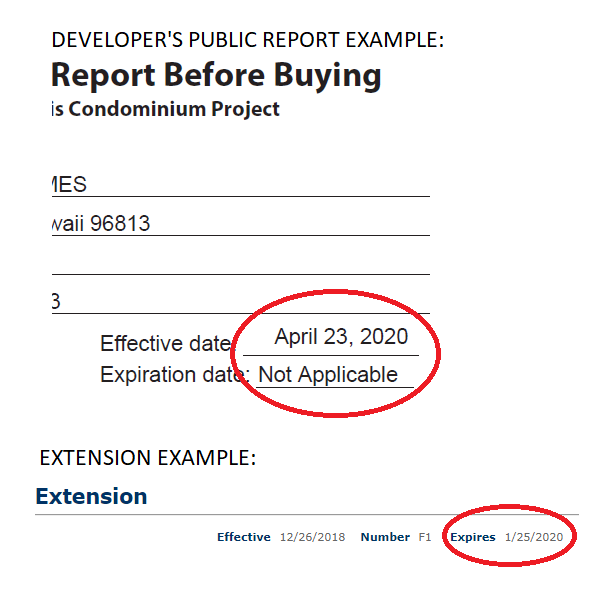
The requirements for the transfer into chapter 514B from chapter 514A, HRS, were that the developer’s public report be active and accurate between January 1, 2019 and July 1, 2020. You can check this by reviewing the effective date or extension date of the most recent report on our database, or on the physical copy of the report or a letter sent to you by the Hawaii Real Estate Commission. Please review this sample for examples of both.
Updated 7/2020
Amending your transferred chapter 514A, HRS project under chapter 514B, HRS utilizes the chapter 514B, HRS forms. Developers use the chapter 514B, HRS, amendment form located on the forms section.
Please review the “Developer’s Guide – Avoiding Common Errors: Chapter 514B, HRS, Amendments to the Developer’s Public Reports” PDF as it contains frequently asked questions on the second page about the specifics, namely that the developer attaches the relevant pages from the chapter 514B, HRS, form with the updated information to the chapter 514B, HRS, amendment form.
To engage in legal sales for units that were never sold, the project must re-register under chapter 514B, HRS. This includes units that are owned by the developer, the inheritors of original owners, and “hui” owners who delegated developer power to a specific individual but were original owners and never sold their units. Please review our developer memo for guidance in this process.
Please review the required forms and general information.
Please review the history of the repeal of chapter 514A, HRS.
Revised 8/13/2020
Condominium Hotel Operator
I have an active Hawaii real estate broker license, can I register as a condominium hotel operator?
Pursuant to the instructions:
“The registration and fidelity bond requirements shall not apply to condominium hotel operators who hold an active real estate brokers license.”
Thus, holders of such a license are exempted from the registration requirements and will run any such operations through their brokerage.
5.9.24
Condominium Association Registration
An Association that cannot obtain fidelity coverage from an insurance carrier registered with the Department of Commerce and Consumer Affair’s Insurance Division can request an exemption under three criteria:
(1) Sole Owner
(2) 100% Commercial Use
(3) 20 or Fewer Units
Otherwise, lack of fidelity bond coverage will result in the loss of registration for that time period, removing the Association’s standing in court as well as access to subsidized mediation.
4.17.25
No. Cooperatives, which fall under chapter 421I, HRS, and homeowner’s associations which fall under chapter 421J, HRS, do not register with the Hawaii Real Estate Commission. The Hawaii Real Estate Commission has no jurisdiction over these types of community associations and thus does not register either during the biennial registration period for condominium association of unit owners (“AOUO”). Furthermore, every AOUO or their contact person is mailed a reminder about the AOUO registration. Cooperatives and chapter 421J, HRS, homeowners associations are not mailed this reminder.
4.17.25
Pursuant to section 514B-103, HRS, only projects or associations with more than five units must register their association and maintain fidelity bonding. Thus, projects or associations with five or fewer units do not register their associations.
Should a number of small projects merge their associations and reach the six unit threshold, then the association would be required to register and maintain fidelity bonding.
9.3.25